
How to Read Fake Book
by Aaron Alon, DMA
Fake book (or lead sheet) scores consist of a melody on the staff with chord symbols above it. These commercial chord symbol will tell you the notes in the chord and the note that should be played the lowest (the bass). This guide will take you through the basics of fake book chord notation.
How to Use This Guide
The further down you scroll in this guide, the more advanced chords you'll see. Scroll down as far as you're comfortable, and you'll pick up some excellent tips for playing chords from a fake book.
Fake Book Syntax
Most fake book chords are constructed using this syntax. We'll cover every part of this and more in this guide.
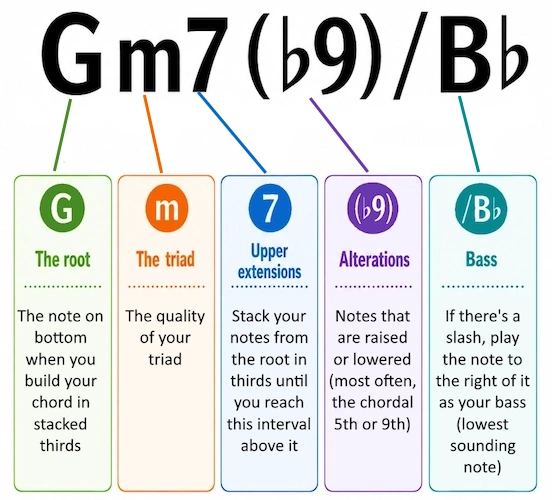
Chordal Elements
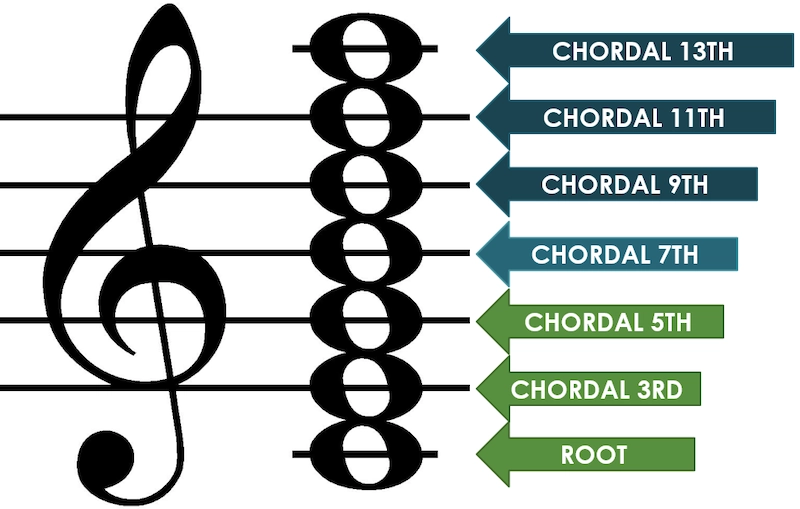
This guide assumes you have a basic understanding of generic intervals, but in case not, you can find the generic interval (unisons, seconds, thirds, fourths, etc.) just by counting the bottom note as 1 and counting the lines and spaces on the staff until you reach the top note. Here's an example, showing how you'd count it:

In Western music, music of our chords are built by stacking thirds on top of each other. Thirds appear as a note on a line and then another note on the next line, or a note on a space and then the note on the next space. When you create chords out of stacked thirds, they'll be on all lines or all spaces unless you switch staves. When chords are written in stacked thirds, the note on the bottom is called the root. The other notes are named for their generic interval above the root. (Instead of "chordal fifth," say, a musician might say "the fifth of the chord" or even just "the fifth.")
Finding Your Bassline
A good way to start with fake book is to play your melody in your right hand and your bassline in your left hand. You can easily extract your bassline from your fake book chord symbols. If there's no slash, the root (what you'll see first in the chord) is your bass. If there is a slash, the note to the right of the slash is your bass.
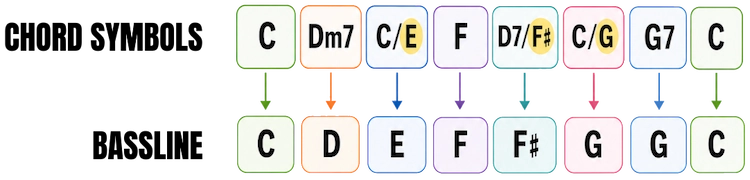
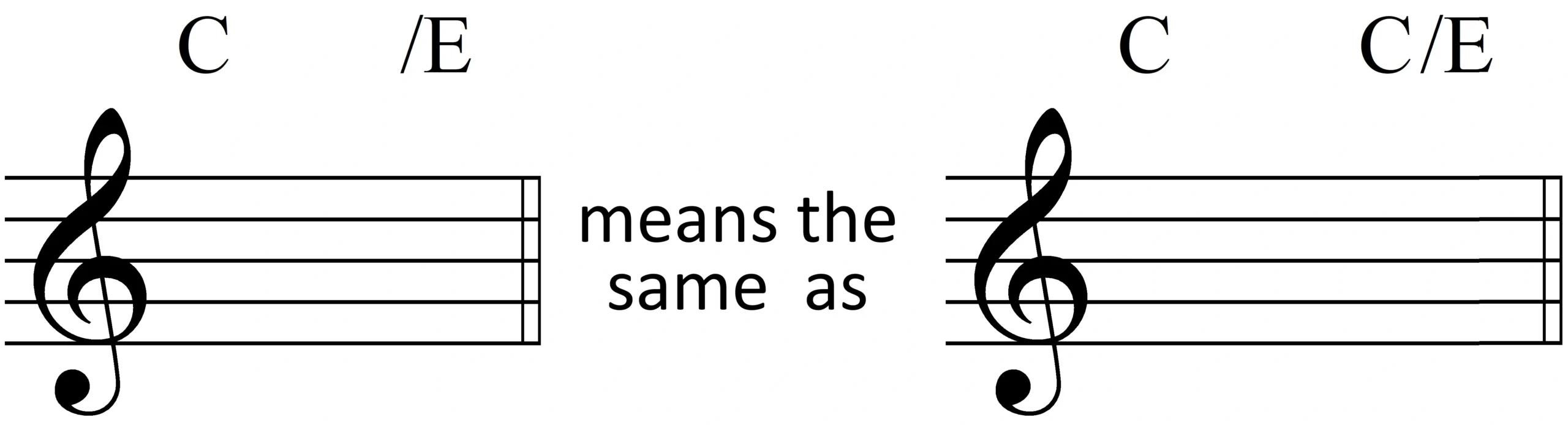
If you ever see a slash with no chord immediately to the left of it, that means that the previous chord continues, but there's a new note in the bass.
Finally, note that the root and bass are always capitalized. Also, keep in mind that the note to the right of the slash doesn't need to be part of the chord. C/B, for instance, is a C major chord (C-E-G), but with B added in the bass.
Playing Chords
Once you get that down, you're ready to work on playing your full chords. Fake book gives you excellent freedom to play each chord in any style, voicing, or pattern you'd like. The chord C major contains the notes C, E, and G, but you can play as many of each note as you'd like, positioned however you want, so long as you make sure that the correct note is in your bass (the lowest note you play), given what we learned above.
Playing Triads
Triads, or 3-note chords, are easily notated in fake book. Here are the four most common triads and how each is constructed and notated. For the intervals indicated, "m3" means "minor third," a third that spans 3 half-steps; "M3" means "major third," a third that spans 4 half-steps.
Major
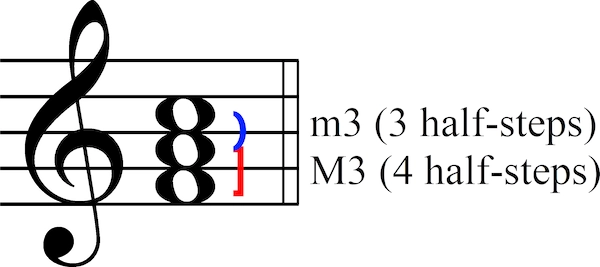
To write major chords in fake book, just write the root, with nothing following it. The chord above is F major; it would be written in fake book as:
F
Minor
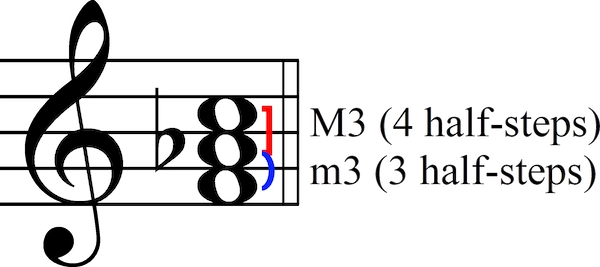
For minor chords, just write the root with an "m" to the right of it. The chord above is F minor; it would be written as:
Fm
You might also see:
Fmi, Fmin, or F-
Diminished
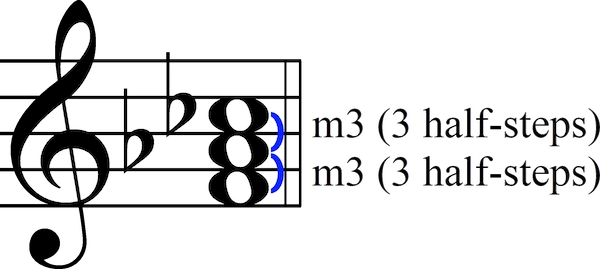
For diminished chords, just write the root, with "dim" or ° to the right of it. The chord above is F diminished; it would be written as:
Fdim
or
F°
Augmented
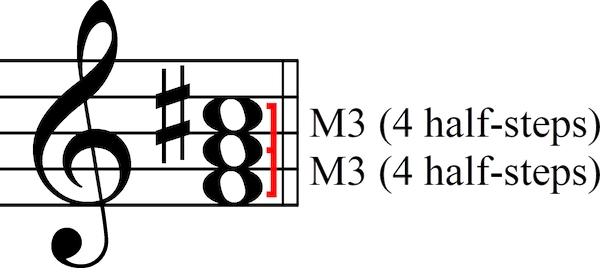
For augmented chords, just write the root, with a + to the right of it. The chord above is F augmented; it would be written as:
F+
Sus Chords
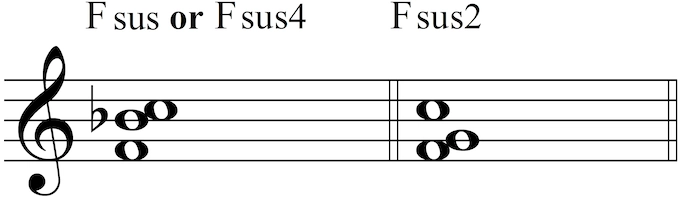
One common modification to our usual triads is what's known as a "sus" chord. "Sus" is short for suspension, named after the non-chord tone from which these chords originate. While not all musicians opt to play these the same way, for our purposes, when you see a "sus4," it means to replace the note a third above the root with the note a perfect fourth above the root. The less common "sus2," similarly, tells you to replace the chordal third with a major second above the root. Since the sus4 is far more common than the sus2, if you just see "sus," it means "sus4."
Upper Extensions
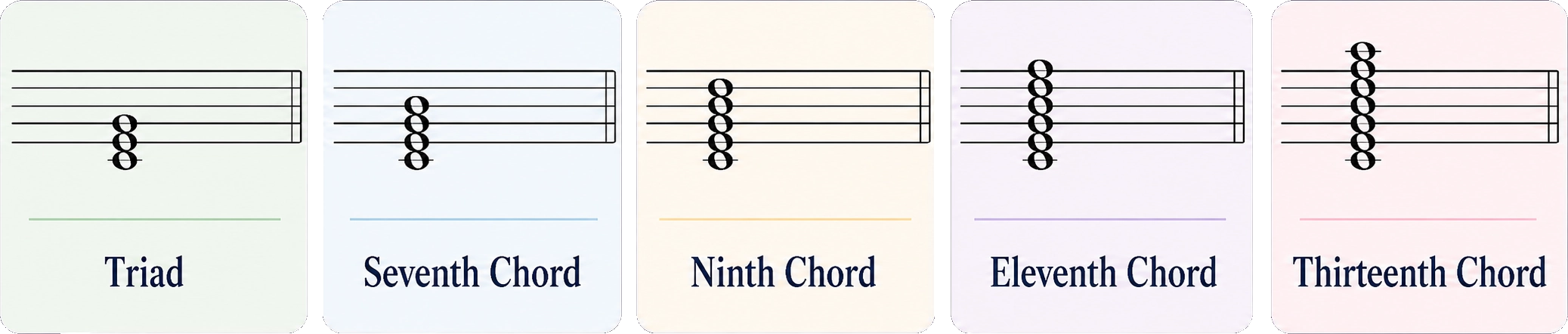
If we continue stacking thirds past the triad (3-note chord), we'll name the chord type based on the largest interval, in stacked thirds, from the root:
Seventh Chords
If you're not ready yet for seventh chords but encounter them in a Vocal Toolkit score, just omit the seventh. In fact, you can reduce 7th, 9th, 11th, or 13th chords down to just their triads, and the chord will still likely work just fine, though you may lose some of the character of the original harmony.
For those ready to tackle seventh chords, it's helpful to know the names of the different types of intervallic sevenths. If you shrink from the octave by one half-step, you'll have a major seventh (M7); shrink by an additional half-step, and you'll have a minor seventh (m7); shrink once again by a half-step, and you'll have a diminished seventh (d7).

Before we learn the fake book system for seventh chords, let's take a look at the classical system for naming them. In this system, we give the root, then the quality of the triad, and then the quality of the intervallic seventh between the root and chordal seventh. Here's a demonstration of that with the five most common types of seventh chords:
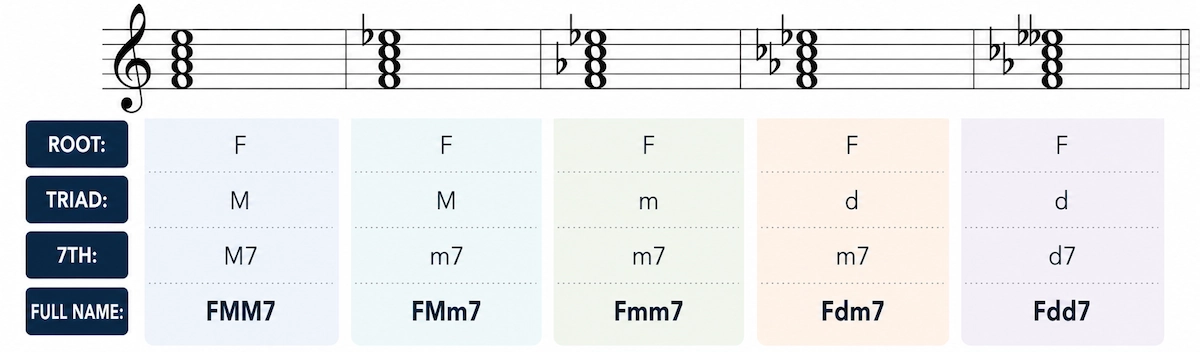
Commercial chord symbols (fake book/lead sheet) follow a different system, but one hint can help you convert three of the five types above: if you say it twice in the classical system (like Fmm7), say it once in fake book (Fm7). That trick covers the MM7, mm7, and dd7. Here are those same five most common seventh chord types, their common names, and how we write them in fake book:
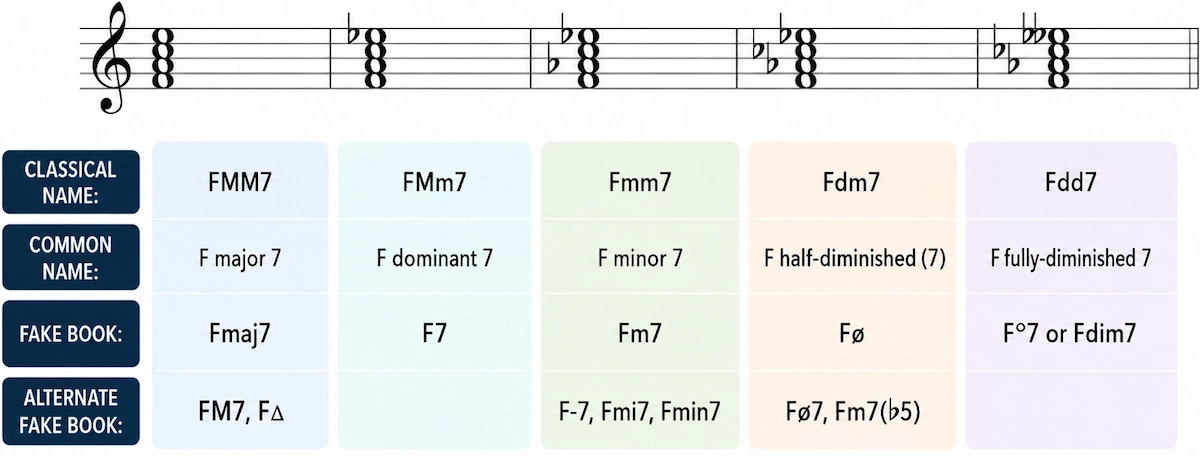
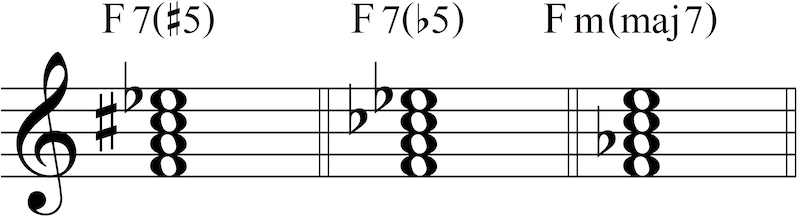
It's unlikely you'd see seventh chord qualities outside of those listed above, but if you do, they'll usually be written as modified versions of the above qualities. Here are some examples:
Ninth, Eleventh, & Thirteenth Chords
While it's unlikely you'll encounter these much in Vocal Toolkit scores, it isn't hard to find your upper extensions. To identify the 9th, 11th, and 13th of your chord, simply play the minor triad a whole step above your root. So, for instance, G7 is G-B-D-F, and G13 is G-B-D-F-A-C-E (A-C-E is A minor, the minor triad a whole step above your root, G). Here are some examples, again using F as the root:

When musicians play these chords, they regularly omit one or more of the notes in the chord (often, the first to go is the chordal fifth).
It's also common for composers to include alterations to these chords. If you see one, simply find the usual note and raise it for a sharp and lower it for a flat. Below are some examples of altered chords. These alterations are all fairly common in jazz and jazz-influenced pieces. The most commonly altered notes are raised or lowered 5ths (see above) and 9ths, but you may also see a ♯11.

Added or Omitted Note Chords
Some chords are created by taking a common chord and adding or omitting notes from it. The most common added note chords (though mostly in post-jazz music), are when you add a major 6th above the root and when you add both a major 6th and major 9th above the root.

For less common additions, composers will usually just write "add" and then the interval above the root to be added. So, Fadd2 would be F-G-A-C. Fadd9 has all the same pitch classes (F-A-C-G), though seeing it written it one way or the other may give you hints about how the composer thinks about voicing it. The same is true of add4 vs. add11. Sometimes, the "add" notation is indicated in parentheses – especially if the triad isn't major – to help you parse the letters, so you're likely to see Fm(add11), not Fmadd11, which looks like F madd 11.
Here are some examples of these uncommon chords:

One frequently-asked question about added note chords is what the difference is between, say, F9 and Fadd9. If you see a 9, 11, or 13, it implies that you're stacking up thirds all the way to that note, whereas "add" just tells you to add that single note. So, F9 is F-A-C-E♭-G (includes the 7th), whereas Fadd9 would be F-A-C-G (doesn't include the 7th).

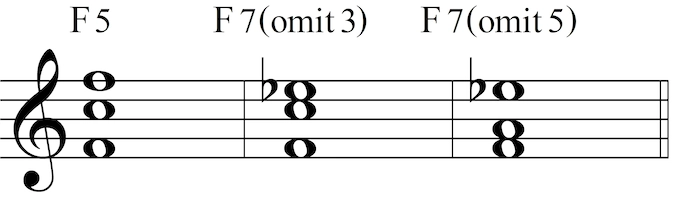
Omitted chord tone indications are very rare. If possible, composers favor "add" over "omit" chords. So, for instance, the chord C-E-G-D could, technically, be written as C9(omit7) or C(add9), but the latter is overwhelmingly favored. However, you may see "omit3" or "omit5" if composers want you to leave out the note that's a third or fifth above your root. So, G7(omit5) would be G-B-F (you're omitting the chordal fifth, D). The only other notation to be aware of is if you see "5." That indicates a perfect fifth, so play the major/minor triad, but omit the chordal third. For instance, C (C major) is C-E-G and Cm (C minor) is C-E♭-G; C5 is just C and G. You may hear rock musicians call these open fifth chords "power chords" (you often double one or more of the notes, as in the first example here):
Enharmonic Spellings
One other peculiarity of fake book is that there are often several different ways to write the same chord. For instance, Dm7/F and F6 are identical in terms of the pitch classes they contain. Choosing one over the other may be reflective of the style or how the chord functions in the piece. For instance, in F major, an add six chord with the tonic (F) as the root would likely be written as F6. However, in C major, you'd more likely see Dm7/F from a classically-oriented copyist and F6 from a jazz-oriented one.
Fake book also allows for simplified spellings or respelled notes. For instance, a German augmented sixth chord in C minor would be A♭-C-E♭-F♯, but in fake book, we'd probably write that just as A♭7 (which spells the final note as a G♭). Similarly, C♯7/E♯ might be respelled as C♯7/F (or D♭7/F) by some writers, and a chord that, functionally, is a C°7/B𝄫 might be simplified to A°7.
In Vocal Toolkit scores, we generally try to reflect the function in the spelling, though we sometimes simplify to facilitate easier reading. We also use simpler chords in the Easy Piano versions and generally restrict ourselves to one chord per beat, which may omit some harmonies or changes in the bass line, especially in highly polyphonic textures, such as were common in the Baroque.
Going Further & Final Notes
There are more possible chords than what we've covered here, but these are usually highly specialized jazz chords (like G7alt, for instance). You can learn more about these in jazz texts, such as Mark Levine's excellent The Jazz Theory Book.
Finally, remember, in fake book, you choose how you voice the chord, how many of each note you have, and the style you play in. More advanced players may reharmonize (change the chords, even in real time, as they play), add or omit notes to chords, or change (or omit) the bass notes (especially if they're playing with a bassist who's covering them). However, for most players playing triads and seventh chords, your best bet is to play all the notes in the chord and ensure that the lowest note is the bass note indicated by the chord.
The contents of this page are ©2026 Aaron Alon. All Rights Reserved.